Yellowstone National Park is famous for its biodiversity and abundance of popular megafauna. Wildlife safaris are one of the most popular activities that visitors partake in because there’s so much to see! Within the ecosystem, there are 67 species of mammals, 285 birds, 7 reptiles, and 5 amphibians. The mammals are generally of most interest to guests, and it’s easy to see why! On the roster are the endangered grizzly bear, the more common black bear, gray wolf, elk, bison, moose, coyote, red fox, pronghorn antelope, bighorn sheep… but I won’t list all 67 species!
There may be a long, long list of wildlife that live in the park, but let’s focus on some of the most popular. It’s always fun to see them, but learning the interesting facts about the habits and biology of each one makes exploring the ecosystem so much more fun! For the animals mentioned above, let’s take a closer look to see what makes them special, and what steps to take to find them in the wild on your visit:


Bear
We are lucky to have two bear species in the Greater Yellowstone Ecosystem- the grizzly bear (Ursus arctos horribilis) and the American black bear (Ursus americanus). These two species share a great deal of similarities, but also have unique characteristics of their own.
One of the most iconic animals in North America, the grizzly bear is a subspecies of brown bear. The term ‘grizzly’ is given to the subspecies that lives in inland habitats, like Yellowstone, as opposed to coastal brown bears that live along coastal areas. In the Yellowstone ecosystem, they weigh anywhere between 300-700 pounds with sows (females) weighing less than boars (males). The grizzly is listed as threatened on the Endangered Species List in the lower 48 states. Once, there were 50,000 grizzlies from the west coast to the Great Plains. With the arrival of European settlers and subsequent overhunting, this number plummeted to just a couple of hundred individuals. In 1975, grizzlies were listed as endangered in order to recover the population that remained in the Greater Yellowstone Ecosystem.
The diet of bears is highly diverse as they are omnivores, consuming both meat and vegetation. Surprisingly, more than 80% of their diet consists of vegetation. Because resources change so much from season to season, bears are very adaptive and focus on the best source of calories that is available at the time. This can range from meat, grass, flowers, pine nuts, berries, fish, roots, termites, and even moth larva!
Bears are famous for hibernating, but surprisingly they are not actually true hibernators as they are not “obligate hibernators”, meaning they do not have to hibernate if conditions allow. An example of an obligate hibernator is the ground squirrel. They hibernate in response to light, comparably to migrating animals. Bears hibernate in response to stressors like cold temperatures, snow coverage, and food availability. In certain parts of the country where these are not a factor, they do not hibernate.
Spring and fall are the ideal time to spot both black bears and grizzlies. In spring, bears emerge from hibernation hungry and searching for mates in lower elevations while the snow is still deep, making them very visible. In the fall, they enter hyperphagia (a phase of increased feeding) while they prepare for hibernation, drawing them out in search of food in the cooler weather. Keep an eye on treelines and in meadows for bear activity. Remember, bears disappear from the landscape during winter while they hibernate.

Gray Wolf
Yellowstone is home to the gray wolf with quite a thrilling conservation story for the species. This iconic animal draws millions of wildlife watchers from around the globe hoping for a chance to experience them in the wild.
In 1995 and 1996 through a cooperative effort between the National Park Service, Fish and Wildlife Service, academia, state wildlife agencies, and environmental groups, the gray wolf was reintroduced in Yellowstone National Park. In the years that followed, many changes- expected and unexpected- occurred resulting in a healthier, more stable ecosystem. Elk numbers declined for the first time in years. Many were alarmed about this, but with less elk overgrazing the vegetation, other species that were forced to leave the degrading environment began to return such as birds and beavers. Beaver populations, which had depleted to negligible numbers, began to rise. Doing what beavers do, they altered the rivers and streams in a way that improved riparian habitats and vegetation for all species in the ecosystem. This is why we refer to wolves as a “keystone species”!
While wolf packs are spread throughout both Yellowstone and Grand Teton National Parks, they can be difficult to find. The best place to search for wolves is Lamar Valley in the northeast area of Yellowstone. Aim for early mornings and evenings before the sun sets. While they can be seen year-round, winter is a fantastic time to spot wolves.

Bison
Bison, the United State’s national mammal, is a majestic and fascinating creature. With cows (females) weighing 1,000 pounds and bulls (males) reaching 2,000 pounds or more, bison are the largest land animal in North America. While they look passive and peaceful grazing in fields, they can run 35/mph and jump 6 feet, making them remarkably agile for their size. This is why it is extremely important to give them their space- they will charge!
We are very lucky that the bison still roams the landscape today. Historic numbers for the bison population were in the tens of millions, over 30 million bison spread across the Western U.S. We almost completely lost them as they were driven to the brink of extinction by early settlers in the late 1800s from overhunting. This overhunting was driven by a couple of factors: it was a money grab for what their hides would earn a hunter and a tactic by the U.S. Government to obtain land occupied by Native Americans.
Bison have a very long breeding season (or “rut”) which begins in July and can linger into October. The height of the rutting behaviors occur in August and is action packed! Males and females usually live in separate herds throughout the year, only coming together during the rut. They have the same gestation period as domestic cows- 9 months before they give birth. Cows will either leave the herd to find a secluded spot, or give birth in the middle of the herd. When bison calves are born, they hardly resemble adults. They are a rusty orange color, which is why they are affectionately called “red dogs”.
Luckily, bison are quite common. They are also very tolerant of summer heat and winter conditions, so while they may alter some of their behaviors slightly, they do not disappear during either season. They are also diurnal, which means they are active during the day. If you’re really aiming for large numbers of bison and some high energy, August is the time to look for bison during the rut!


Elk
Elk are members of the deer family and are significantly large in size. Cow elk (females) stand about 4.5 feet high at the shoulder and weigh between 500-600 pounds. Bulls (males) are even larger, averaging 5 feet at the shoulder and can weigh between 800-1000 pounds. On top of that, bulls grow impressive antlers that can spread as wide as four feet, and can weigh up to 20 pounds each!
During the hotter months of July and August, elk seek cooler temperatures and good summer forage which often sends them deeper into the forest and up into higher elevations, which can make them more difficult to see. During this time, bull elk are growing their antlers. They are “in velvet”, meaning that the growing antlers are covered in a layer of skin that has very short fur on it giving them a velvety appearance. This skin is packed full of blood vessels to give the antlers a direct supply of blood and calcium to grow them as fast as possible- as much as an inch a day!
One of the best times of year to view elk is in the fall- September and early October. This is the height of the elk’s breeding season where they come down to lower elevations as the dominant bulls claim their harems. By this time, their antlers are fully grown, and the bull elk are in their full, majestic glory. As their hormones change, blood supply cuts off to the layer of skin and the elk scrape their antlers up against trees to remove the velvet, a process that only takes a day or two.
Elk herds are very visible this time of the year, and they are very active! Dominant bulls are busy breeding with the females, but they also have to keep other males who don’t have their own harems away. This is when you might see some chasing, posturing, and potentially fighting! One of the most magical elements of fall is the call of the bull elk, also called a “bugle”. The bugle is a show of dominance and a way to attract mates. This long, high pitched call can be heard around the park, even when you can’t see them.
While it is possible to see elk all year round, spring and fall are when they are easiest to find. We recommend fall for the ultimate elk experience as you see massive racks of antlers and hear the ethereal bugling with a backdrop of beautiful golden fall leaves! The best time of day to see them is right around dawn and dusk when they come out into the open to graze.

Moose
Moose are the largest member of the deer family, and their staggering size is the first thing anyone notices about them. There are eight subspecies of moose found around the world with four of those found in North America. The moose found in the Greater Yellowstone Ecosystem is known as the Shiras moose and is the smallest of the four. While the smallest, these moose can still stand at 6 feet at the shoulder and weigh over 1,000 lbs!
Moose, unlike elk and bison, are not grazers, meaning they do not eat grass. They are “browsers”, so they feed on leaves and branches of woody plants such as willow, aspen, and mountain ash. Because these plants are not a good source of sodium, moose also feed on aquatic plants such as duckweed, pondweed, and algae for more salt. This is why we often see moose hanging out in the water. Browse is not as abundant as grass, so it does not support large numbers of animals at a time. Moose are mostly solitary animals because of their food source.
Fall is one of the most exciting times in the region. The leaves change color, and the animals are in rut! This is another term for a breeding season. Throughout the spring and summer, bull moose grow their antlers in preparation for the rut. Their antlers behave the same as the elk, shedding and regrowing every year with a fuzzy “velvet” layer of skin over them while they are actively growing.
Usually solitary, moose will gather in small groups during the rut. There will typically be one large bull with two or three females. Other bulls will challenge for the right to mate, leading to displays of dominance that can lead to vicious fights.
The moose population is less than 100 in Yellowstone, so they are not a common sight in this park. Grand Teton National Park has a denser moose population of around 400 and plenty of prime habitat. Look for them around ponds, rivers, and streams around dawn and dusk during the summer months. October is the moose rut, so they are very active and visible from the roadsides. Keep your distance! Moose can be aggressive and maintaining 25 years is park law for a reason. After the rut and as winter moves in, moose are very prevalent in open sagebrush habitats as they graze on taller vegetation that doesn’t get covered by the snow.


Coyote
Coyotes are prevalent on the landscape throughout the Greater Yellowstone Ecosystem. They play a vital role in the health of the ecosystem as opportunistic predators of rodents, small mammals and the offspring of larger animals such as deer. They are often mistaken for wolves, but they are significantly smaller with an average weight of 30 lbs. They are not as tall, standing at less than two feet, they have larger ears and longer, pointier snouts than wolves, and they are not quite as shy.
Coyotes are often spotted on their own either on the move or hunting rodents in a field. We don’t tend to see much of them otherwise, and there’s a lot about them that people don’t know. They are incredibly intelligent and extremely adaptable, able to adjust to whatever hardships life throws their way. They can live in rugged wilderness in extreme winter climates, hot deserts, and even urban areas. They can even be found in Central Park in New York City! They are true survivors.
Coyotes are monogamous, so they pair up for life. They are extremely loyal partners, only choosing another mate if one dies. They breed once a year and exhibit a family unit much like humans. Male pups will disperse up to 9 months old, but females will often stay with their mother. They do not form packs in the traditional sense, their group is simply a family unit. They travel and hunt alone, so they are generally spotted solo.
To spot a coyote, just keep an eye out! They often pop up at any place, any time. Like most animals in the region, they are more active at dawn and dusk. They are often mistaken for wolves but with some basic knowledge of coyotes, they are easy to distinguish. They are a treat to watch as they utilize their skillful mousing tactics, listening intently and pouncing. You’ll find yourself cheering when they successfully pull a vole or pocket gopher from the ground!
Red fox
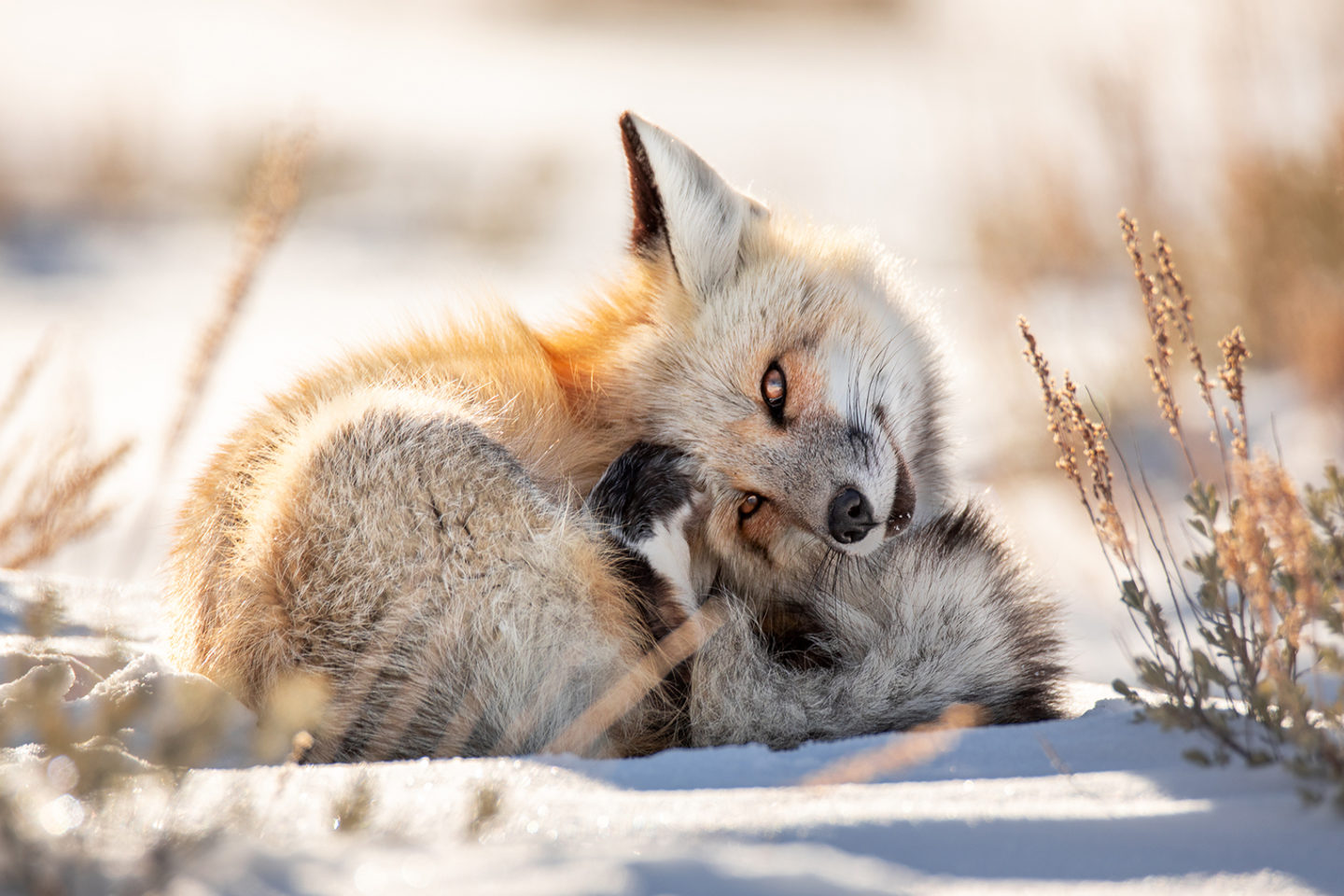
Red foxes are a beautiful animal to find in Yellowstone National Park. The smallest of our three canine species, they are very charming to observe as they hunt for rodents under snow and soil. The only species of fox present in the Greater Yellowstone Ecosystem is the red fox, but they can have highly variable coat colors that range from light blonde to black! Females (vixens) weigh about 10 pounds with males (dogs) weighing slightly more at 11-12 pounds.
While foxes are solitary hunters and generally seen on their own, they live in family groups. Both parents are active in raising the kits and are known to be socially monogamous. This means that while they may mate with other foxes, they stay together as partners for life. Their mating season is around January, and they will have about four to five kits in a litter.
Foxes are more nocturnal than their other canid relatives, although they can still be seen during the day, particularly during winter. They increase their activity during dawn and dusk and generally prefer habitats closer to forested areas rather than wide open sagebrush. In late April and May they may be seen more frequently as they must forage more to feed their newborn kits.


Pronghorn Antelope
The pronghorn antelope is one of the most interesting and unique species we have in North America, and many people haven’t even heard of them! They are only found in Western North America from southern Canada to Northern Mexico. They are called antelope, but they are not true antelope. While they closely resemble African antelope, they are a completely different species and not at all genetically related.
The pronghorn antelope has many special talents. They are incredibly fast, earning their place as the second fastest land animal in the world at a whopping 60mph! They co-evolved with the North American cheetah which went extinct 12,000 years ago, so they evolved their speed to survive. Their eyesight is extraordinary on top of that, it is as powerful as 8x binocular magnification. Because they are so fast and can see so far, you will not see pronghorn wander into wooded areas. This would make them extremely vulnerable. They are safest out in the open where they can see predators coming and have plenty of space to outrun them.
Pronghorn antelope are very common in the GYE and are diurnal animals, meaning they are active during the day. They migrate south in the winter and are generally one of the last to migrate back up north for the summer months, so you can expect to start seeing them in June. They can often be seen grazing in the same areas as herds of bison.

Bighorn Sheep
There are three species of wild sheep across North America: the bighorn sheep, the Dall sheep, and the Stone sheep. The sheep that reside in the Greater Yellowstone Ecosystem are the largest of them all, the Rocky Mountain bighorn sheep.
These stocky sheep are built to withstand harsh winter climates with thick fur and bulky stature. They can weigh anywhere between 150-300 pounds with males on the larger side. A pair of their enormous horns alone can weigh up to 30 pounds!
Bighorn sheep are known for their incredible acrobatics in impossibly steep terrain. Adapting to rugged cliff faces keeps them safe from many predators as they are able to leap and bound at breathtaking speed. They may not look like an animal that could effortlessly scale a rocky precipice, but their strong legs and specialized hooves help them move with ease. Their cloven hooves are flexible and have a rubber-like surface on the bottom of them, helping to grip onto even the smallest protrusion.
The physiology of a bighorn sheep ram is one of the most fascinating evolutionary traits. Their curled horns are made of keratin, which is the same tissue that makes up your hair and fingernails, and its flexibility absorbs much of the shock on impact. The science goes even further than that, however. Along with a thicker and heavier skull, there is an additional type of bone in a section of the horn that is more foam-like, with pockets of air within it that also absorb a great deal of shock. Recent studies show that these animals don’t escape completely unscathed; post-mortem brain samples show signs of early brain injury, but considering how much of a beating their skulls take, that is extremely impressive! Scientists study the physiology of bighorn rams for bioinspired ways to develop protections for pro athletes to avoid major brain injuries throughout their careers.
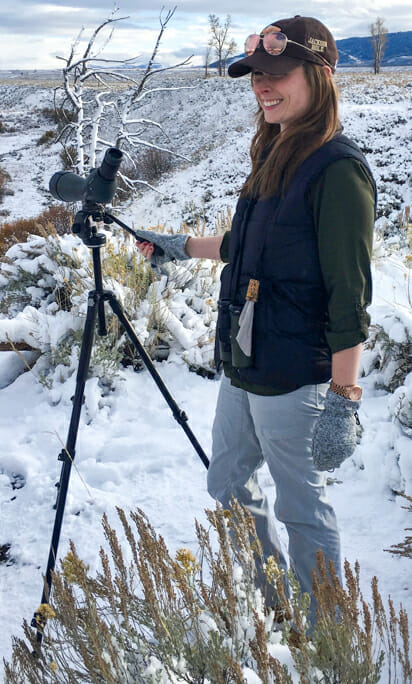
During the summer months, bighorn sheep reside in high elevations on steep mountain slopes. Typically, the only way to see them is through a spotting scope from a great distance if you know where to look. Sylvan Pass by the east entrance of Yellowstone has great bighorn sheep habitat, so sometimes you can encounter them there right by the roadside. The winter months are the best for bighorn sheep watching. The deep snow in higher elevations pushes most sheep down lower in search of more protected winter ranges. Miller Butte on The National Elk Refuge is one of these winter ranges making bighorn sheep one of the most abundant winter wildlife species, sometimes even right on the road!


Now that you know some of the special characteristics that make these species unique, you should feel better equipped to search for them while you explore the park. Knowing the habits of an animal makes it much easier to put yourself in the best position for a sighting, which is why guided tours are so popular and successful! Our experienced, knowledgeable guides know the ecosystem and its wildlife extremely well, and they are driven to give you the best wildlife experience possible when visiting Yellowstone.
This written guide is a good start, but you will be amazed at the wealth of information that you will receive from your guide in the field. Whether you choose a day tour or a multi-day excursion, this ecosystem is so diverse and dynamic that there is always something fascinating to learn!
Call now and secure your spot on one of our safaris!
FAQs
What wildlife is Yellowstone National Park most famous for?
Yellowstone is known for its concentration of large mammals, including grizzly bears, black bears, gray wolves, elk, bison, moose, pronghorn, bighorn sheep, coyotes, and red foxes. The park protects 67 species of mammals overall, making it one of the most wildlife-rich regions in North America. Many visitors join wildlife safaris to increase their chances of seeing these iconic species in safe and responsible ways.
Where are the best places to see wildlife in Yellowstone?
Different animals prefer different habitats. Wolves are most reliably seen in Lamar Valley. Bears often appear along forest edges and meadows in spring and fall. Elk gather in lower valleys during the rut in September and October. Bison roam throughout the park, especially in Hayden and Lamar Valley. Moose, while uncommon in Yellowstone, are occasionally seen near rivers and wetlands, with higher densities found just south in Grand Teton National Park. A guided tour helps you target the right habitats at the right times of day.
What time of year is best for wildlife watching?
Spring and fall offer excellent visibility for many species.
-
Spring: Bears emerge from hibernation, elk cows and bison cows give birth, and predators become more active.
-
Fall: Elk and moose enter the rut, bears forage heavily, and bison remain widespread in the valleys.
Wildlife can be viewed year round, but seasonal habits—such as hibernation, migration, and breeding behavior—determine what you are most likely to see.
How do I safely view wildlife in Yellowstone?
Always follow National Park Service guidelines: stay at least 100 yards from bears and wolves and 25 yards from all other wildlife. Use binoculars or spotting scopes instead of approaching animals for photos. Never feed wildlife, and remain aware of your surroundings, especially in areas with reduced visibility. Guided wildlife tours offer expert instruction on safe viewing practices so you can enjoy wildlife ethically and responsibly.
Why should I take a guided wildlife safari instead of exploring on my own?
Professional wildlife guides understand animal behavior, identify subtle clues in the landscape, and know where wildlife is most active throughout the seasons. They use high-powered optics, communicate with other guides, and navigate the park efficiently to maximize sightings. A guided safari also provides deeper insight into the ecology, conservation history, and unique adaptations of Yellowstone’s species—turning sightings into meaningful wildlife experiences.
Wildlife Safari
Keep Exploring